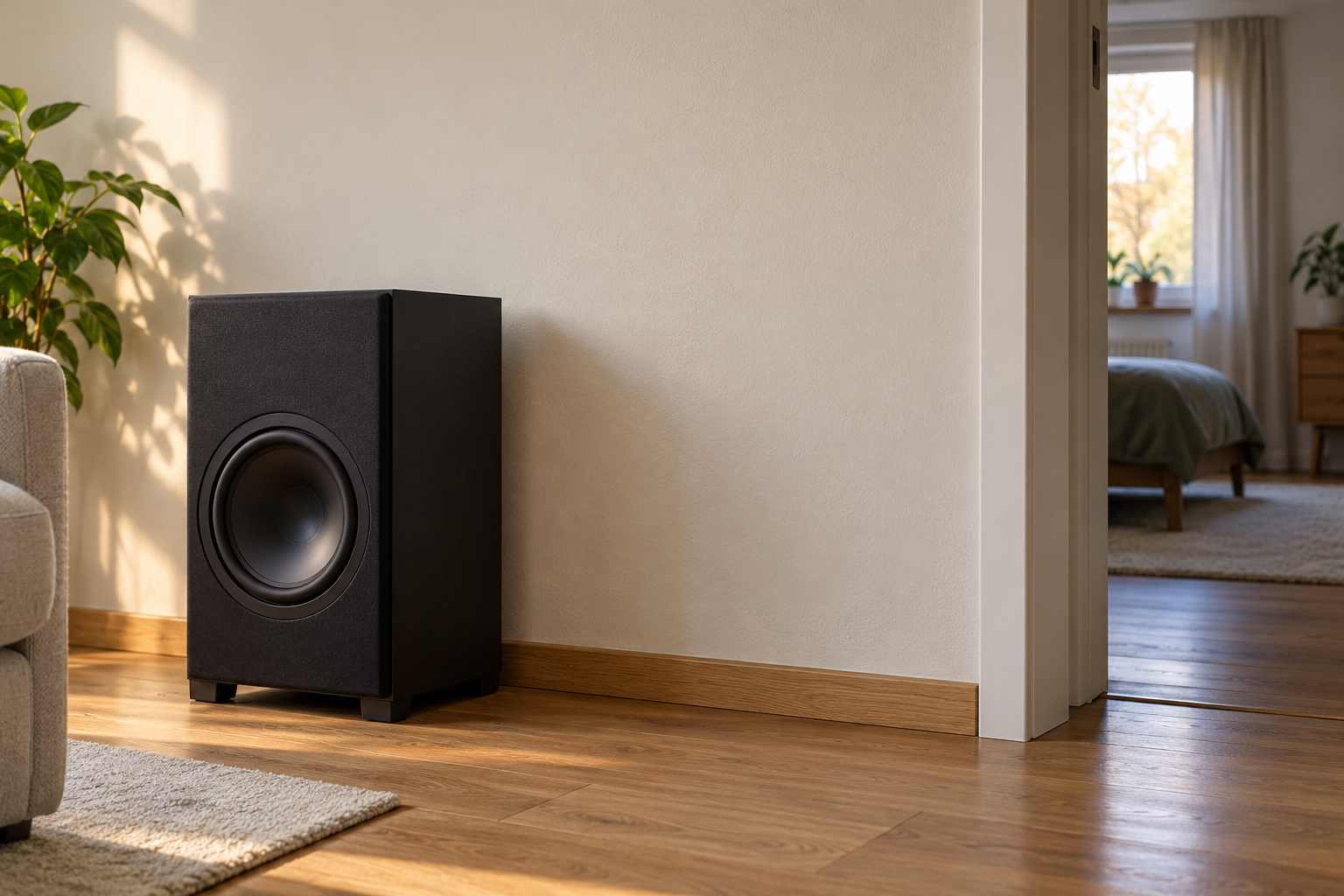
From the room next door, a song can lose its words and keep its pulse. The crisp edge of a voice fades; a low note remains as a soft throb. It is tempting to imagine that bass simply slips through a wall because its wavelength is long. The wall is doing something more physical, and the answer depends on how the rooms are joined.
Sound begins as a changing pressure in air. When that pressure reaches a partition, some energy reflects, some is lost in the materials, and some sets the partition in motion. Its moving surface then pushes air in the next room. A wall can act, imperfectly, like a broad loudspeaker. A UK Environment Agency technical report describes this sequence: airborne sound becomes structural vibration, then airborne sound again. The low note has not carried a parcel of air through solid plaster. Energy has crossed by making a new source on the far side.
Why the lower note gets less help from the wall
Consider a simple, solid panel before considering a whole building. Its resistance to sound depends partly on its mass per square metre and on the frequency striking it. Under the ideal mass law, doubling that surface mass improves sound reduction by about six decibels at a fixed frequency; doubling frequency gives roughly the same improvement at fixed mass. The Environment Agency report states both relationships and stresses that they are idealizations. On that simple model, a low note encounters less isolation than a note an octave higher at the same incident level. Real music does not arrive with equal levels at every frequency, and a real wall is not an ideal panel, but the direction of the effect explains a familiar part of the experience.
The wall also has its own preferred ways of moving. A light sheet of plasterboard can flex. Two layers separated by an air space can behave like masses connected by a spring: the trapped air supplies the spring. Near the resulting mass–air–mass resonance, a double wall can transmit more sound than a smooth mass-law prediction would suggest. Heavy construction has resonances too. This is why simply adding one more surface does not guarantee an improvement at every low note.
Alf Warnock's 1991 measurements of concrete block walls with attached drywall show the hazard in a particular construction. The depth of the cavity behind the drywall, the way the drywall was fastened, and the presence of fibrous material changed the frequency response. Some attachments increased transmission at low frequencies even when other frequencies improved. The study measured down to the 63-hertz band precisely because the usual higher-frequency data could miss a troublesome dip. Its lesson is about the tested block-and-drywall assemblies, not a claim that adding drywall always makes a room noisier.
The useful design idea is separation with control. The wall faces should not be tied together more rigidly than their structural job requires; otherwise vibration can cross the connection. Absorbent material inside an appropriate cavity can damp some resonances, but it does not replace mass, airtightness, or separation. In a 2011 set of wall tests, Wilson Byrick found that a double-stud construction gave better low-frequency transmission loss than simply adding drywall to the tested assembly. Those particular results are not a universal improvement figure. They show why the path between the two faces matters as much as the number of boards visible from either room.
The route may avoid the wall
There is another reason a low note seems to come through a partition: it may have gone around it. Floorboards, joists, ceilings, service spaces, and adjoining walls can carry vibration across a room boundary and radiate it somewhere else. Acousticians call these flanking paths. The National Research Council of Canada's guide to wood-frame buildings describes how continuous structural elements and wall–floor junctions bypass the nominal separating wall. Improving the wall alone can leave the audible route through the floor intact. The guide concerns wood-frame assemblies, so a masonry or concrete building needs its own path analysis.
Sound can also take a literal air path. A gap at the wall's top or bottom, an unsealed pipe penetration, a door, or back-to-back electrical boxes can undermine a heavy partition. The US National Bureau of Standards' Quieting handbook lists such leaks and recommends sealing them. A gap is not a bass-only tunnel: higher frequencies can leak through it as well. That distinction matters because hearing a throb in the next room does not, by itself, identify whether the main route is a flexing panel, a connected floor, or open air around the edge.
There can also be a more direct mechanical start to the journey. Equipment resting on a floor can put vibration into the structure before the airborne sound has even met the separating wall. The Environment Agency report describes machinery supports exciting floors and the vibration later re-radiating from other surfaces. A sound system on a shared floor may have both an airborne path and a contact path. The remedy for one path may leave the other untouched.
A number that misses part of the note
A wall is often advertised by a single sound-transmission-class, or STC, figure. That number is useful for comparing assemblies under defined conditions, but it folds a frequency curve into one score. The NBS handbook's explanation of STC uses bands from 125 to 4,000 hertz and discusses the rating in relation to intruding speech. A 60-hertz note falls below that range. Two walls with similar headline scores can therefore behave differently for a bass-heavy source, and a laboratory wall score need not describe the completed building with its junctions and gaps. For low-frequency noise, the measured sound reduction by frequency is more revealing than one number.
England's Approved Document E treats a separating wall and its flanking construction together. Its details call for sealed joints and attention to connections around masonry, framed walls, and service openings. The document is building guidance for England, not a diagnosis of any particular room. Its practical emphasis follows from the physics: a good panel is only one part of the route between source and listener.
The surviving low note is evidence of a chain, not proof that bass is immune to walls. It may have driven a panel, found a resonance, followed a joist, or slipped through an opening. To understand why it is heard, follow the energy from the source to the receiving air, and ask at each junction what is allowed to move.
A thought worth keeping?