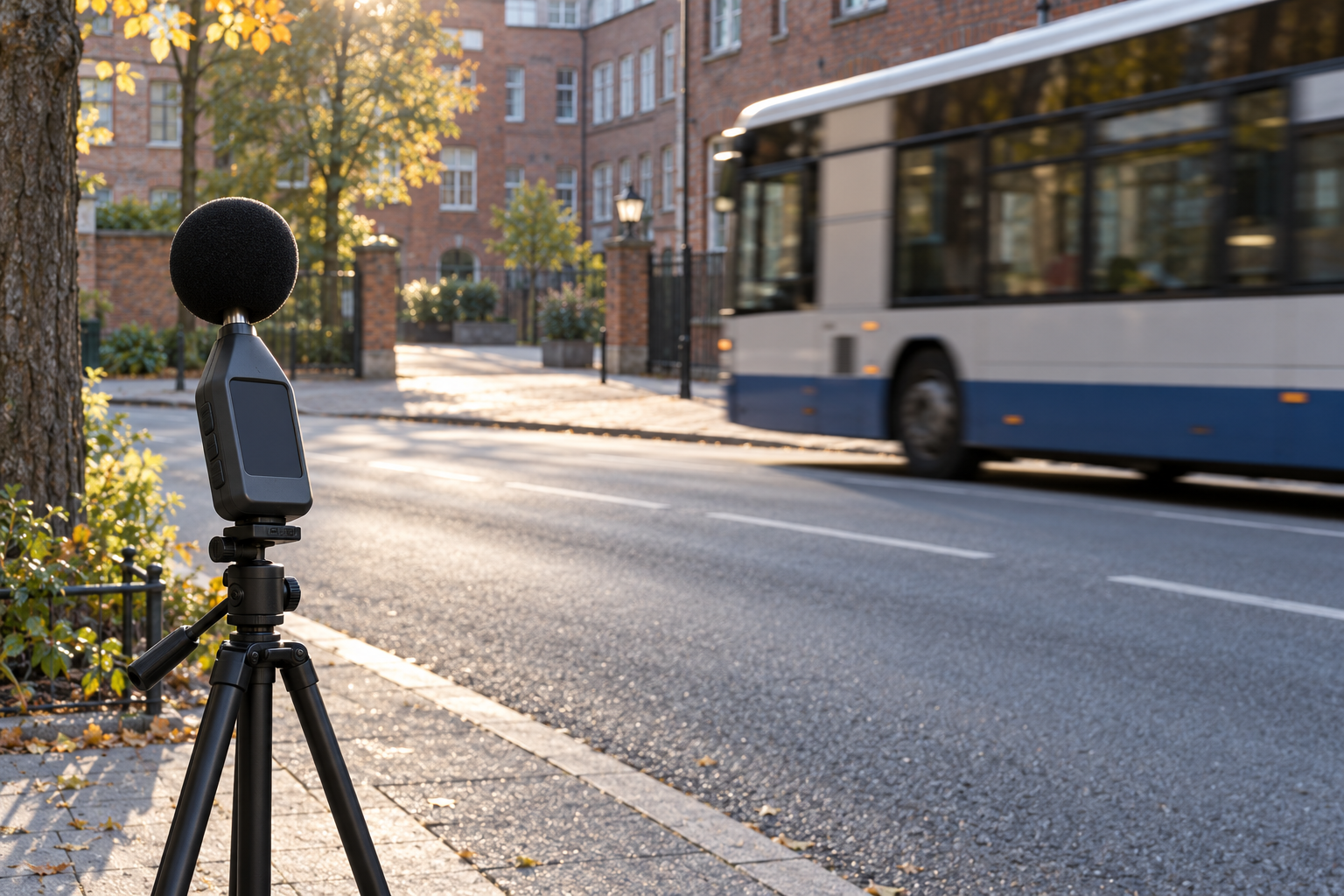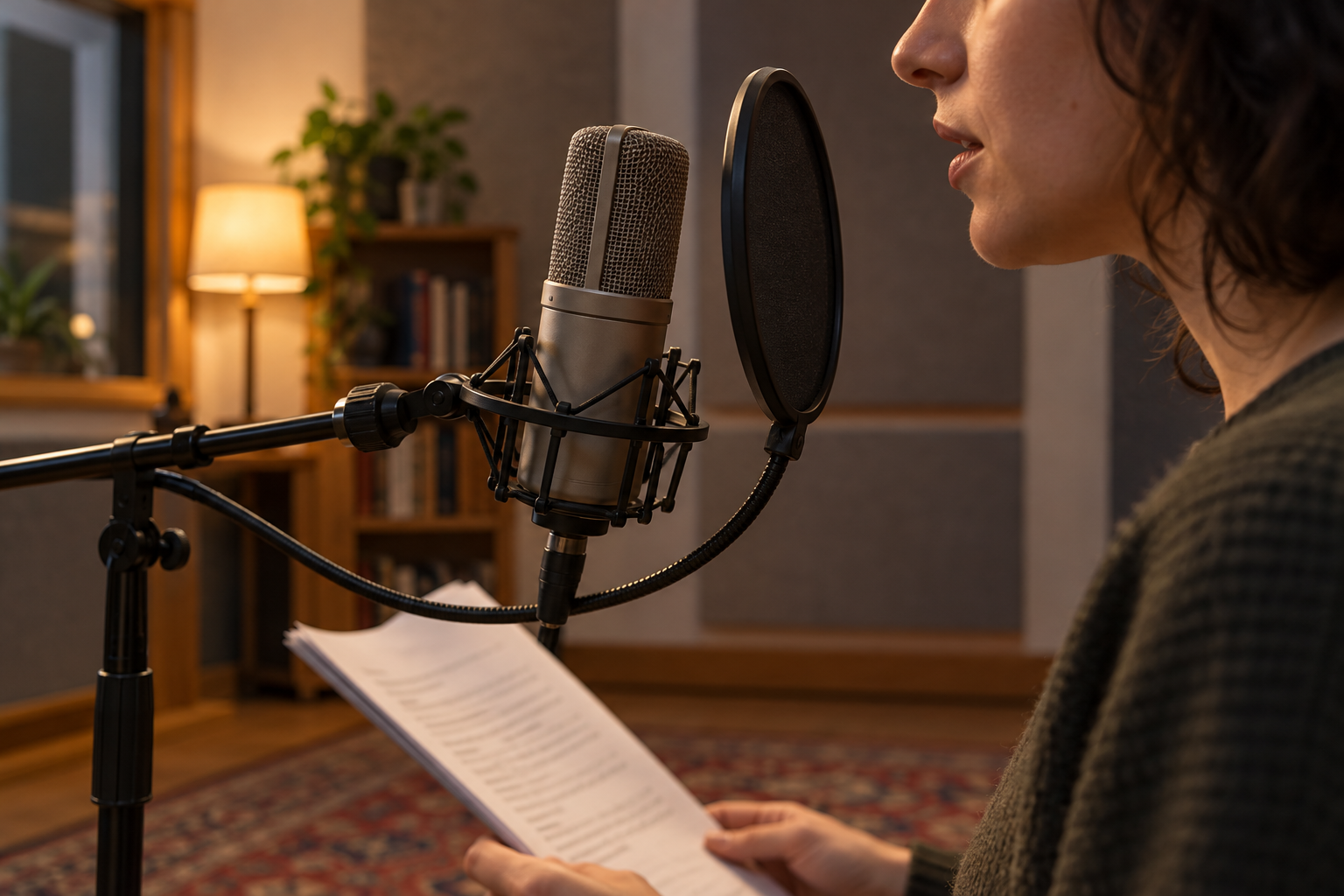
Move a microphone from the far side of a desk to a place just in front of a reader's mouth, and the words may seem to come from a different room. The reader has not changed the sentence. The recording now gives more weight to the direct voice, less to the sound returning from the walls, and perhaps more to the low notes in that voice. Turn the microphone a little and the balance can change again. These are choices made before any plug-in or equalizer touches the track.
A microphone converts the sound pressure it receives into an electrical signal. It receives that pressure at a particular place, with a particular sensitivity to frequency and direction. The International Telecommunication Union's 2018 guidance on recording real-world noise fields makes the spatial limit explicit: a single microphone records what reaches its position, while one channel alone does not preserve the full direction of the sound field. Its recommendation is written for controlled noise recordings, but the physical point applies to a spoken sentence or a guitar: the microphone cannot capture a room independently of where it stands in it.
Distance chooses how much room arrives
The sound that travels straight from a mouth or instrument weakens with distance. Reflected sound has travelled through other paths and is spread around the room. Move the microphone closer to the source and the direct sound usually gains ground over those returns. The Shure recording-techniques guide uses this direct-to-ambient balance to explain why moving a microphone can make a recording seem close and dry or distant and spacious. It also notes that a hard tabletop or music stand can send an early reflection back toward a vocal microphone. A room's influence is not merely the long echo heard after a sound stops.
In the desk example, pulling the microphone near the reader may make consonants easier to hear against the room. It can also expose breath, lip noise and changes in how far the reader leans forward. The Shure guide suggests keeping a consistent mouth-to-microphone distance and using a pop filter to limit blasts of air on plosive consonants. Those details matter because the recorder does not know which variations belong to the performance and which came from the changing geometry of capture.
Moving away has a use too. A musical instrument sends different parts of its sound in different directions. Close to an acoustic guitar, a microphone can emphasize the patch of wood or strings nearest its capsule; farther back, more of those components reach it together, along with more room. Shure's examples describe distance and angle as ways to seek a desired tonal balance, not as distances that make every guitar sound “natural.” The player, instrument, room and intended effect all change the choice.
Direction is a frequency-dependent choice
Microphone labels such as omnidirectional, cardioid and figure-eight describe how their sensitivity varies around them. An omni responds broadly around its capsule. A cardioid favors the front and reduces much of what arrives from behind; a figure-eight receives sound from front and back while rejecting the sides. These patterns are made by different ways of exposing the diaphragm to sound. DPA's technical guide to microphone specifications explains the difference between pressure operation, in which sound reaches one side, and pressure-gradient designs, which compare sound reaching front and rear paths.
A polar pattern is therefore a map of sensitivity, not a wall that keeps unwanted sound out. A voice aimed at the front of a cardioid may dominate a quiet sound behind it, but the microphone will still receive sound from the sides and some reflections from many angles. More subtly, a pattern can change with frequency. The same DPA guide warns that a single polar diagram, often drawn at one frequency, may conceal different rejection at low and high frequencies. Reflected sound arriving off axis can lose some frequencies more than others, so rejection can change its tone as well as its level.
One manufacturer's own measurements make the point concrete. Neumann's 2010 U 87 Ai operating manual prints separate polar plots at several frequencies for its selectable omni, cardioid and figure-eight settings, alongside on-axis response curves. The plots belong to that microphone and its stated free-field measurement conditions. They show why a single pattern name or a “20 Hz–20 kHz” range is an incomplete description of what a side wall's reflection will sound like in a track. To change the recorded room, sometimes the meaningful move is to change the angle at which that reflection reaches the capsule.
A reader who turns away also changes the sound travelling toward the capsule, especially speech's higher-frequency detail. Mark the reader's position and the microphone's aim before assigning every tonal change to equipment.
Close placement can add bass of its own
There is another change when a directional microphone approaches a source. A pressure-gradient capsule responds to the difference between sound reaching two acoustic paths. Very near a source, the change in pressure across those paths alters its low-frequency output. Engineers call the resulting bass rise the proximity effect. A pressure-operated omni does not have this same proximity effect, though its output still grows louder as it approaches the source, and a real microphone may become somewhat directional at high frequencies because of its body and diaphragm size.
The distance and capsule design matter more than a blanket “close mic” rule suggests. In a 2007 anechoic-chamber experiment, Wieslaw Woszczyk and colleagues compared a pressure microphone, a pressure-gradient microphone and a particle-velocity probe at fourteen distances between two centimetres and three metres from a small broadband source. The pressure microphone's frequency-response curves stayed roughly parallel as distance changed; the tested pressure-gradient microphone gained substantial low-frequency output at distances below about thirty centimetres. That threshold describes their equipment and source, not every singer or capsule.
A 2024 study by Neumann engineer Georgiy Zadvitskiy examined the geometry inside pressure-gradient condenser capsules and compared a model with near-field measurements. It found that polar pattern and capsule construction affect the bass rise; its simplified model agreed especially well at low frequencies, with larger discrepancies above 500 hertz. In a voice recording, moving closer may therefore increase bass for one directional microphone more than for another. It may be a useful sound, or it may obscure words. The effect is an acoustic property to audition, not a reason to assume the voice itself became bassier.
The capsule and circuit leave their marks
Even when position and pattern are fixed, two microphones need not produce the same signal. Their on-axis frequency responses can emphasize or reduce different bands. A response chart has to be read with its measurement distance and direction: DPA notes that directional microphones can change their response with source distance, so a distant test curve may not describe close speech. Its guide also separates sensitivity—the output voltage for a stated sound pressure—from sound quality. Higher sensitivity can require less preamplifier gain for a quiet source; it does not by itself promise a more faithful recording.
The quietest and loudest parts set other limits. DPA defines a microphone's equivalent noise level as the acoustic level matching its inherent electrical noise; that floor becomes more noticeable when recording a faint sound and then raising the level. At the other end, the capsule or its electronics can distort under high sound pressure. Neumann's U 87 Ai manual gives a specific example: a switchable attenuation increases that model's maximum usable sound-pressure level by 10 decibels, while a high-pass filter can reduce low-frequency interference or compensate for proximity effect. Those controls are not universal properties of condensers. They demonstrate that the microphone's settings can change the signal before it reaches the recorder.
The rest of the chain still needs headroom. Neumann tells users to set the following equipment's gain so that the loudest input does not distort. A clean-looking waveform at one stage cannot repair overload that has already occurred inside a capsule or earlier circuit. Conversely, a noisy recording may contain room noise, electronic noise or both. Listening to a short test at the intended level can identify which problem is actually present before a different microphone is blamed or purchased.
For a useful comparison, keep the reader, words and room as steady as practical. Record a short passage at two measured distances, then at two angles; note pattern, filter and gain settings. Match playback levels before judging clarity or bass. Listen between words for room sound and hiss, and on strong syllables for air blasts or distortion. Then connect each audible difference to a physical change.
A recording is made where the microphone is, not everywhere the source can be heard. Its distance decides how much of the source and room meet at the capsule. Its pattern and off-axis response decide which arrivals survive with their tone intact. Its own mechanics and electronics impose further limits. A few centimetres of movement can change all three at once; understanding which one changed is how a microphone becomes a deliberate way of hearing.
A thought worth keeping?