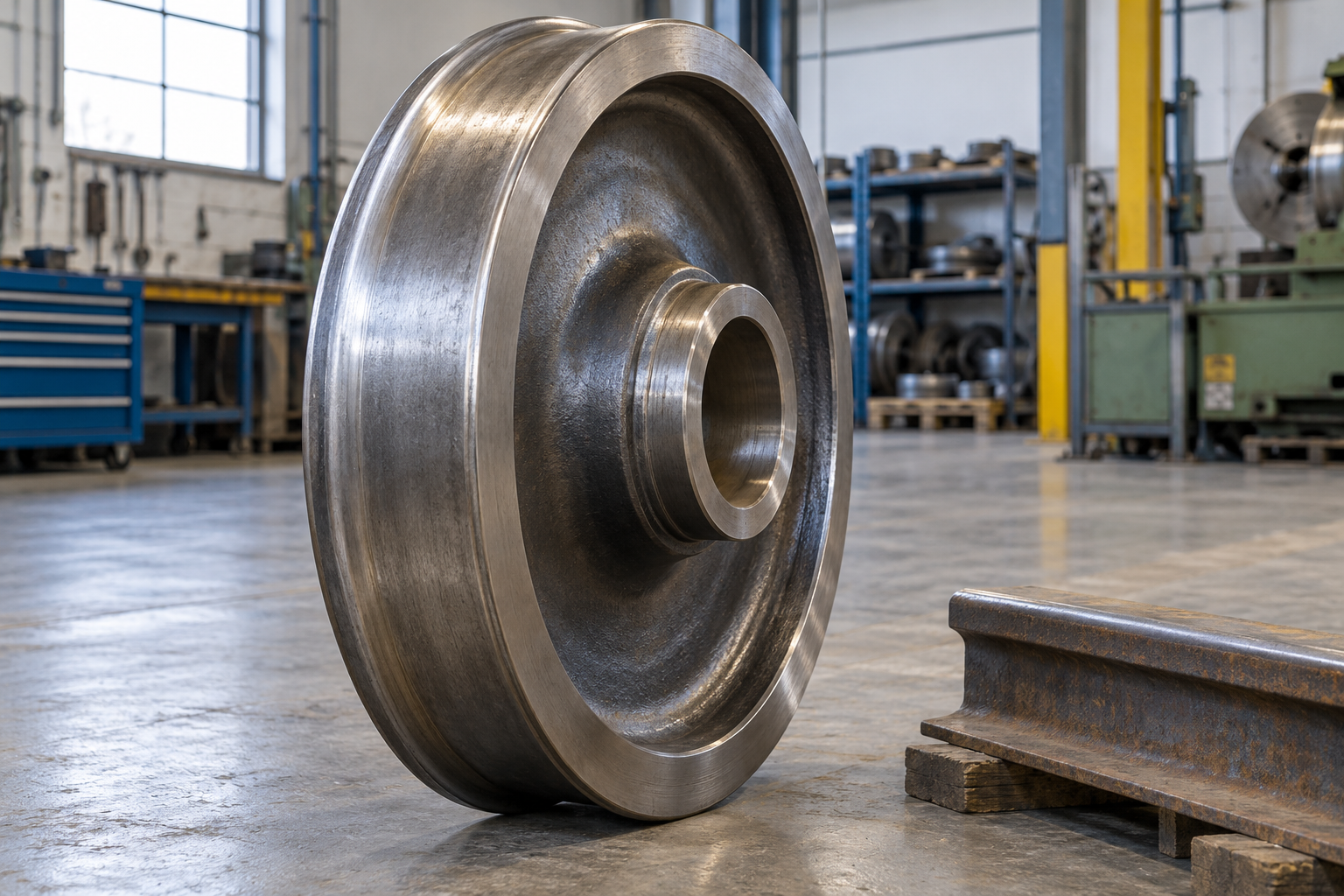
A railway wheel looks simple from a platform: a dark circle passing too quickly to examine. Seen off the train, it is a shaped piece of steel. A rim carries the running tread, a hub meets the axle, and a thinner web joins them. That web may be straight, offset or corrugated. Its shape helps decide how the wheel bends when the rail strikes back through the tiny contact patch. It also helps decide which parts of that vibration become sound.
The wheel is one instrument in a larger, unwilling orchestra. Small unevenness on both its tread and the rail head excites the contact as the train moves. Wheel, rail and supporting track then vibrate and radiate at different frequencies. The European Union Agency for Railways' noise assessment traces rolling noise to the combined roughness of wheel and rail, and links wheel roughness in part to braking equipment. A beautifully shaped wheel with a rough tread can still be noisy. A smooth wheel on rough rail cannot solve the contact by itself.
The web changes the voice
A wheel does not vibrate as one rigid disc. At particular frequencies, its rim and web can flex in patterns called modes. In some, different sectors move in and out; in others the disc moves sideways. Geometry changes the frequencies of those modes and how strongly the wheel responds when the contact force excites it. That is one reason the web's profile matters, even though it never touches the rail.
Researchers at Japan's Railway Technical Research Institute tested wheels with different web shapes both on a train and on a stationary wheel-and-axle assembly. In their 2006 running and bench study, a lighter corrugated-web design had more noise in particular frequency bands than another corrugated design under the tested conditions. Their near-field sound mapping located peaks on the wheel web that helped explain the running-test bands. The paper does not prove that every corrugation is louder than every straight web. It shows the danger of treating a lighter wheel or a lower overall number as a complete description of the sound it will make. A shape can move energy into a band that stands out.
That design problem is more exacting than making a plate thick enough to stop ringing. The wheel has to carry loads through many cycles, fit the vehicle and track, and avoid adding unnecessary mass. In a Chalmers University design study, Jens Nielsen and C. R. Fredö varied wheel radius, web thickness, the web's sideways offset and the curves joining web to rim and hub. Their model sought low rolling noise while meeting fatigue-strength and mass constraints. Adding a damping layer to the web improved their modeled result further, but their example accepted a heavier wheel. The reported reduction concerned the wheel component under a specified load case, not the sound level of an entire train passing a home.
A later wheel-shape optimization study at the Universitat Politècnica de València made the trade more visible. Its researchers modeled changes in wheel radius, web thickness, fillet radius and offset, checked candidate shapes against high-cycle fatigue requirements, then estimated rolling-noise radiation. Some modeled candidates cut the wheel's A-weighted sound power by up to 5 decibels relative to their reference wheel. In their chosen design space, successful shapes tended toward thicker webs, larger joining curves and straighter web profiles. The authors also checked how the changed wheel might shift sound to rail, sleepers or train structure; the total modeled sound power still fell for their selected designs. Those are useful design findings, but the number belongs to the simulation's wheels, track assumptions and excitation, not a guarantee for every route.
A curve can make a different sound
The steady hiss or roar of rolling is not the same as a high, sustained squeal on a bend. A curve changes the direction and forces at the contact. Under some conditions, frictional forces and the wheel's vibration modes can feed a tonal sound. A wheel shaped to reduce ordinary rolling radiation may still need another answer to a squeal problem.
In a Korean railway study, researchers measured wheel modes, reproduced squeal and flange-related noise on a roller rig by changing contact conditions, and compared those results with measurements on an urban curve. The match between measured tones and wheel modes helped identify which vibration mattered there. Their evidence came from a particular rig and railway curve; it does not assign one frequency or cause to every squealing train. A South African heavy-haul field study found tonal squeal on some inner wheels even on curves about a kilometre in radius, with predominantly longitudinal creepage rather than the simple picture of a wheel scraping sideways around a very tight bend. The researchers favoured a mode-coupling explanation for those observations. Together, these studies make the diagnostic point: listen for the type of noise and measure the contact before choosing a wheel treatment.
One treatment adds damping to the wheel rather than altering the steel's outline alone. A ring seated in a groove can take part in a vibrating mode and reduce its response. Brunel and colleagues' original study examined preloaded metal rings for curve squeal and found that coupling between ring and wheel modes, rather than simple sliding friction alone, explained the attenuation they studied. Its effectiveness varied with ring and wheel. A damping device is therefore a design for particular modes, not a charm to hang on any noisy wheel.
The shape must survive service
The tread changes as a wheel runs and brakes. Surface roughness or a damaged spot changes the force fed into the wheel, even if the web underneath is the same as on its first day. The ERA assessment notes that some brake-block technologies roughen running surfaces more than others; it assesses brake changes together with wheel reprofiling. That is why maintaining the round, smooth running surface belongs beside acoustic wheel design. The web sets possible responses, while the tread and rail supply much of the excitation.
Even the way sound leaves the wheel depends on its surroundings. A 2025 in-situ radiation study modeled a wheel with nearby rail, ground, bogie and car body. It found that those neighbours changed the direction in which sound radiated across the frequency range, while their effect on wheel sound power was mainly at lower frequencies. A wayside listener hears a wheel in that setting, not an isolated test disc in free air.
The quietest useful shape is consequently a negotiated one. It moves troublesome modes away from strong contact excitation, loses energy through appropriate damping, and still carries its loads within limits of mass and fatigue. It relies on a maintained tread and a rail whose surface does not keep striking it. The wheel's web gives the noise a voice, but the line it runs on supplies the rhythm. Designing one without measuring the other leaves the most important part of the sound unexplained.
A thought worth keeping?