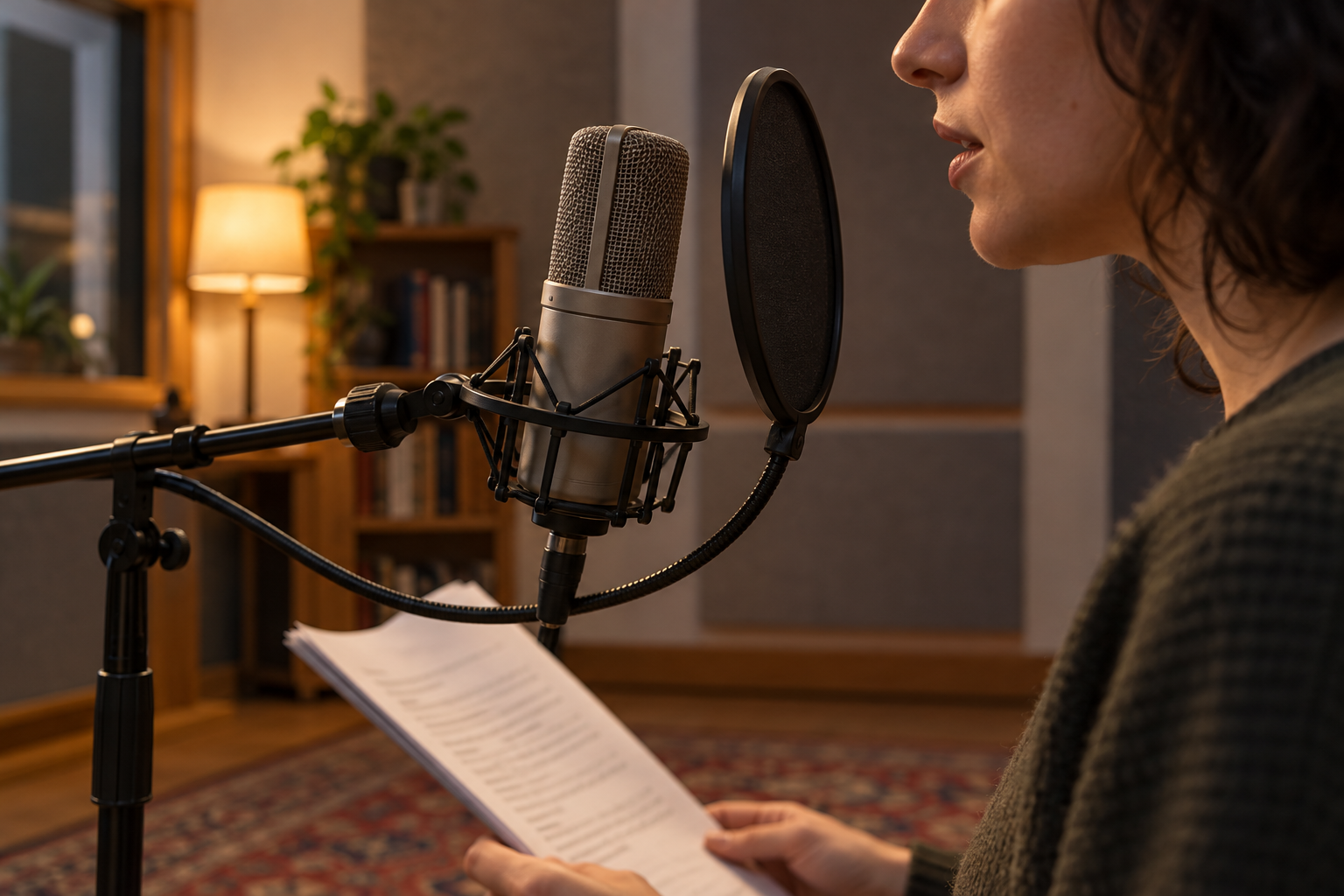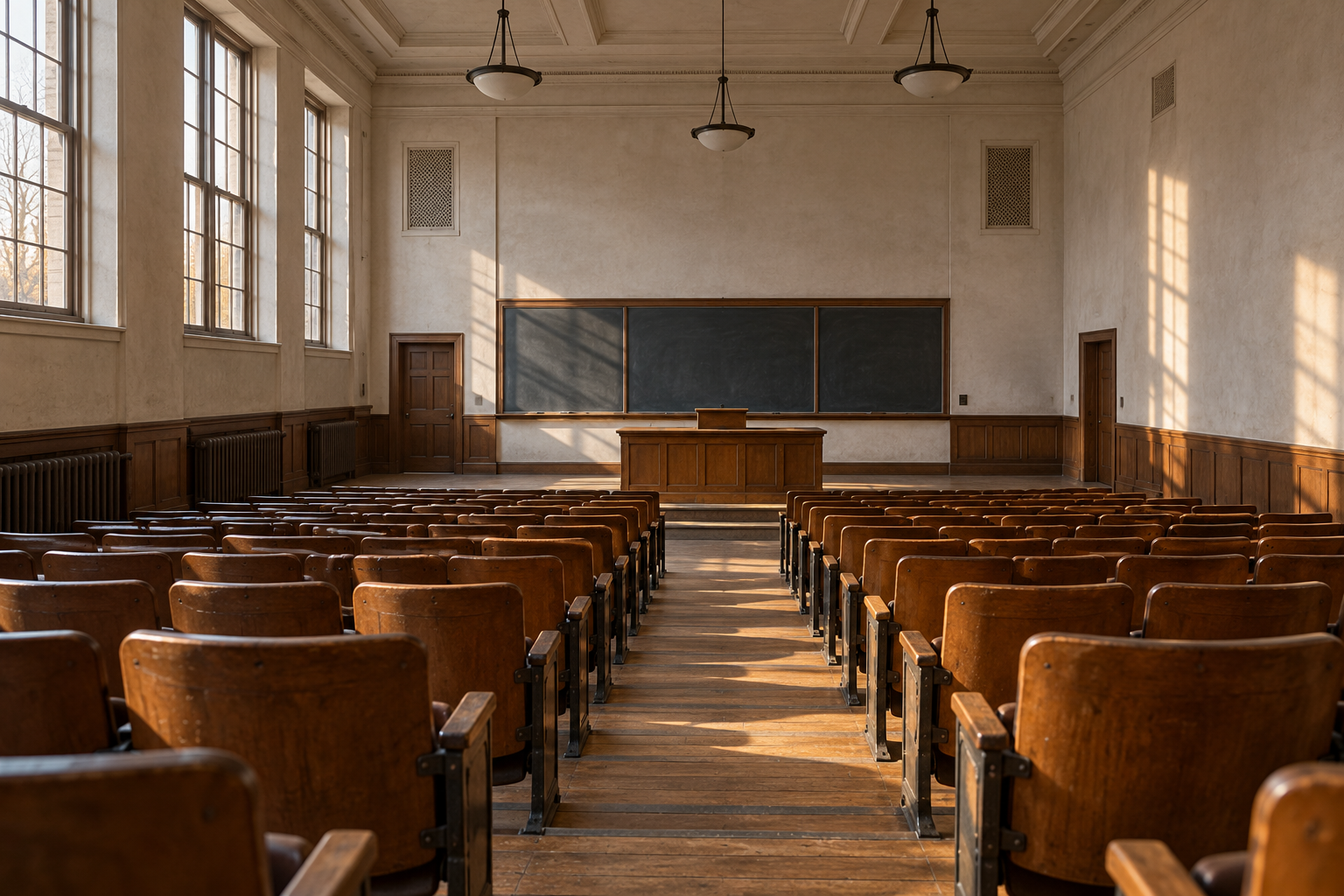
A hand clap can end before the sound of it does. In a furnished bedroom, the remaining sound may be brief enough to escape notice. In a bare hall, it can hang in the air, losing its edges as it fades. The hands have stopped moving; the room is still returning the clap. That interval is one way to hear the shape and surfaces around you.
The first sound to reach a listener travels directly from the source. Some of the same energy meets a wall, floor or ceiling and arrives later by a longer path. A few of these early returns can stand apart. As reflections multiply, they overlap into a denser tail. In a study of impulse responses from 271 spaces, James Traer and Josh McDermott found a typical progression from sparse early reflections to a diffuse decay. The spaces ranged from interiors to outdoor locations, mostly around Boston. Their measurements give an acoustic description of a familiar sensation: the sound after the clap no longer seems like a second clap, yet it still belongs to the room.
What the tail measures
Acousticians can make the room's response visible by exciting it with a test signal and recording what follows. They call the result an impulse response. It contains the direct arrival, the first distinct returns and the fading field that follows them. A common summary is reverberation time, often written RT60: the time associated with a 60-decibel drop in sound level after the source stops. It is a useful way to compare decay, even when a measurement estimates that span from a smaller audible portion of the tail.
The historical example is almost comically concrete. A National Institute of Standards and Technology account of Wallace Sabine's early work says he used a 512-hertz organ pipe, a stopwatch and his ear to investigate Harvard's Fogg Lecture Hall. Empty, it had a reverberation time of about 5.5 seconds; speech sounds lingered into those that followed. Cushions, drapes and carpet added absorption and shortened the decay. The lesson is physical as well as historical. In Sabine's simple relationship, a larger volume tends to lengthen the reverberation time, while more absorbing surface tends to shorten it. The NIST account cautions that the equation works in an averaged, restricted sense, not as a complete portrait of a particular seat in a particular hall.
One number also cannot tell us which parts of a sound linger. In the 271-space survey, decay varied with frequency. Midrange bands tended to persist longer than very low or high ones in the measured spaces. The pattern reflected the rooms and materials in that sample; it is not a rule that every room's middle notes must last longest. The important point is that a room can let one part of a voice fade while another remains. Two spaces with a similar broadband RT60 can still have different early returns and different frequency profiles.
The measurement is especially tempting because it offers a clean target. A National Research Council Canada classroom model treats the late sound as a diffuse, exponentially decaying field and calculates speech measures alongside background noise. Those assumptions are useful for comparing room designs. They also mark the boundary of the calculation: a room's best decay time for speech cannot be chosen independently of noise, distance and the paths the sound takes before it becomes diffuse.
The reflections that help
It is easy to blame every reflected sound for a blurred sentence. A late tail can indeed carry one syllable into the next. But an early reflection can deliver useful speech energy to a listener whom the direct sound reaches weakly. In speech tests and room measurements published by Canada's National Research Council, added early reflections improved intelligibility for listeners with and without hearing impairment. In the rooms they measured, these returns raised the effective signal-to-noise ratio by as much as 9 decibels. That is an upper result from particular rooms, not a promise that any hard wall makes speech clearer.
A Danish experiment with nine normal-hearing listeners makes the distinction finer. The researchers simulated a classroom's direct sound and twenty early reflections, the last arriving about 55 milliseconds after the direct sound. Raising those reflected components improved speech intelligibility in their test, but less than an equivalent rise in the direct sound. An early return can reinforce a word without being as valuable as a clear path from the speaker. Later energy, noise and the balance between them remain part of the problem.
This is why a room for speech is not improved by chasing the shortest possible decay alone. Remove every useful early return and a distant voice may grow weaker. Leave too much late energy and words begin to overlap. A classroom, a lecture hall and a music room place different demands on that balance. Even within one room, the listener at the back and the speaker at the front receive different proportions of direct and reflected sound.
The listener learns a little
The room changes what reaches the ear; the listener's recent experience can change what they make of it. In a 2010 experiment with fourteen listeners, Eugene Brandewie and Pavel Zahorik played speech in simulated reverberant rooms. When listeners first heard a short carrier phrase in the same room, their average masked-speech threshold improved by 2.7 decibels, corresponding to an average intelligibility gain above eighteen percentage points in that task. The benefit was absent in the simulated anechoic condition and much smaller with one-ear listening. The authors describe perceptual adaptation as a possible explanation; the result does not mean a listener can always learn away a room's bad acoustics.
Traer and McDermott found another clue in their perception tests. Listeners could make judgments about a sound source and its environment from reverberant audio, but did worse when the decay was altered to depart from the statistical patterns of measured spaces. The ear seems to use some expectations about how natural reverberation behaves. We do not hear a recorded tail as a simple list of wall bounces. We hear an event in a place.
When the source falls silent, the room's response briefly becomes easier to notice. First there may be a return with its own direction; then a thinner, more blended remainder; finally the background noise covers what is left. The decay cannot tell the whole story of a hall from one clap. It can tell us that the room has kept some energy moving after the hand that made the sound has come to rest.
A thought worth keeping?